
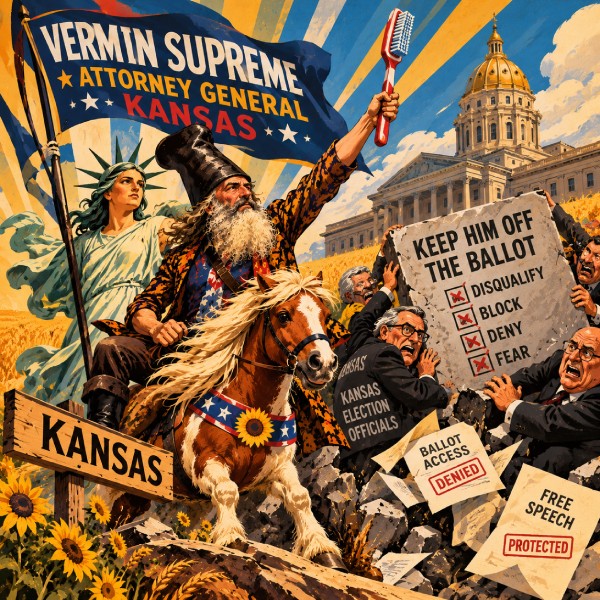
Vermin Supreme v. State of Kansas

Attorney
Vermin Supreme v. Kansas: When the State Tried to Keep a Satirist Off the Ballot
Vermin Supreme wanted to run for Kansas Attorney General. Kansas officials tried to prevent his candidacy. The resulting controversy raised a serious constitutional question: who gets to decide which candidates voters are allowed to consider?
Vermin Supreme is best known for wearing a boot on his head, carrying an oversized toothbrush, and promising free ponies to every American. But behind he delivers a serious political message: satire exposes the contradictions, empty promises, and self-importance of electoral politics.
When Supreme sought to run for Attorney General of Kansas, state officials resisted his attempt to appear on the ballot.
The dispute implicated a fundamental principle of representative democracy: the government cannot exclude a political candidate merely because officials consider his campaign ridiculous, unconventional, or embarrassing.
Although states possess legitimate authority to establish candidate qualifications and administer elections, those powers are constrained by the First and Fourteenth Amendments. Ballot-access restrictions can burden political association, political expression, and voters’ ability to support candidates of their choosing.
Supreme’s candidacy presented those questions. His campaign was deliberately satirical, but the constitutional issues were not. Political expression does not become less worthy of protection because it employs comedy, exaggeration, or an enormous toothbrush.
The actual dispute—and the result
In June 2018, Supreme sought to challenge incumbent Attorney General Derek Schmidt in the Kansas Republican primary for Attorney General. His candidacy drew an objection from Kansas Republican Party executive director Jim Joice, who argued that Supreme was not a Kansas resident. But, the Kansas Constitution permitted candidates from out of state — because when it was drafted, there were not very many qualified candidates in Kansas.
On June 11, the Kansas State Objections Board voted 2–0, with one abstention, to remove Supreme from the ballot. Board members relied on residency reasoning drawn from a recent state-court decision concerning gubernatorial candidates. But whether that reasoning extended to the office of attorney general was disputed.
Supreme responded with a federal lawsuit, Vermin Love Supreme v. Kansas State Elections Board, No. 18-cv-1182-EFM (D. Kan.). The complaint asserted First Amendment, procedural due process, and substantive due process claims, together with claims under the Kansas Constitution.
The central legal question was whether state officials could impose a residency qualification on Supreme’s candidacy through their interpretation of election law, particularly where the statutory basis for excluding him was contested.
Supreme sought emergency relief to restore his place on the ballot. On July 3, 2018, the federal court heard arguments on his request for a temporary restraining order. The court’s subsequent memorandum addressed that request, but after a full day of oral argument, we are sad to report that we did not prevail.
And while the sight of a presidential candidate wearing a boot on his head and running for Kansas Attorney General might seem like a joke, the government should not have an unrestricted power to determine which candidates are sufficiently conventional to deserve to be on the ballot.
Given that there was insufficient time to appeal before the election, we took our ponies and went home in defeat, but with our heads held high.
Case documents
Press
| KCUR / Kansas News Service | The Overlooked Power Spots On The Ballot In Kansas On Tuesday |
| Sunflower State Journal | Vermin Supreme kicked off ballot |
| KCUR / Kansas News Service | Congressman Ron Estes Gets ‘Rep’ By His Name On Ballot Against Other Ron Estes |
| The Iola Register | State primary contests promise excitement |