
Vermin Supreme v. Concord
Attorney
Vermin Supreme takes on Concord, New Hampshire, Hillary Clinton, and the Secret Service
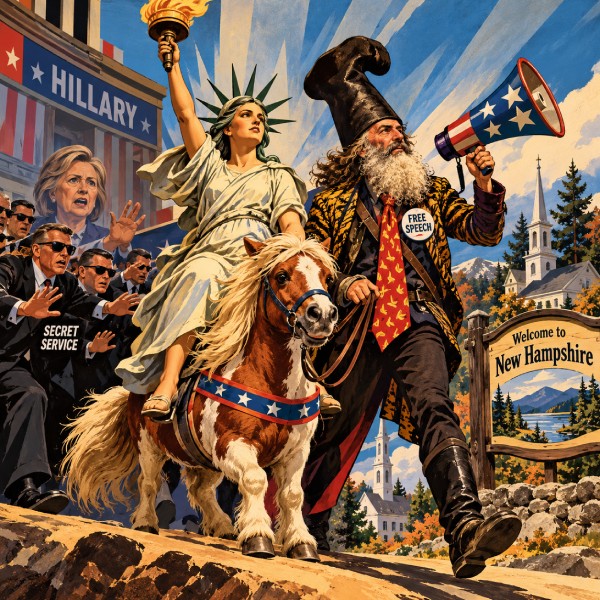
When Hillary Clinton came to New Hampshire, Vermin Supreme wanted to bring two ponies to protest her. The City of Concord said no. So he called his First Amendment counsel, Marc Randazza.
In December 2017, presidential candidate and political satirist Vermin Love Supreme (yes, that is his legal name) prepared to protest Hillary Clinton’s book signing at Gibson’s Bookstore in Concord, New Hampshire. He was upset by a passage in Clinton’s book, What Happened, that used a hypothetical promise of free ponies to criticize Bernie Sanders’s political messaging.
There was just one problem: free ponies for every American had been Vermin Supreme’s signature campaign promise for years. Supreme considered Clinton’s remarks an affront to his political platform and decided to respond in the most appropriate way imaginable: by appearing outside her book signing with two actual ponies.
Concord officials acknowledged that ponies were ordinarily permitted at that location but refused permission for the date of Clinton’s appearance. A city licensing officer explained that the police did not want the ponies interfering with the event and referenced coordination with the Secret Service. The Secret Service apparently could not vouch for Clinton’s safety if there were miniature ponies present. (If only the Taliban knew that weakness in American military power).
The city was willing to permit the ponies on another day, but not when Clinton would be there.
Represented by Marc J. Randazza and locak counsel Arpiar (Matthew) Saunders, Supreme filed a federal civil-rights lawsuit on December 1, 2017, alleging violations of the First and Fourteenth Amendments and the New Hampshire Constitution.
While we can all laugh at the story, the First Amendment issues were serious.
Political symbolism is protected expression. Supreme’s ponies were not merely animals accompanying a protester. They were the living embodiment of his political message. Excluding them burdened the very expression he intended to communicate.
The government cannot simply relocate a protest to a time when its message loses its meaning. Supreme wanted to respond to Clinton at her book signing, not demonstrate outside an empty bookstore the following Tuesday. The complaint raised the question whether the city’s refusal was a legitimate, content-neutral safety restriction or an unconstitutional prior restraint designed to prevent political embarrassment or disruption.
Under 42 U.S.C. § 1983, Supreme sought declaratory and injunctive relief, damages, and attorneys’ fees.
The case illustrated an enduring First Amendment principle: political speech does not lose constitutional protection because it is ridiculous, theatrical, inconvenient, or accompanied by livestock.
The government may regulate genuine safety concerns. It cannot suppress political expression merely because the speaker intends to make a spectacle of himself—or because his audience might prefer not to see the ponies.
The outcome: The ponies prevailed
The case ended quickly and favorably for Mr. Supreme. On December 4, 2017, just three days after the complaint was filed, the City of Concord agreed to settle and allow Supreme to bring his ponies to the protest. The city arranged a parking space across from the bookstore as a “Free Speech Paddock.”
On December 5, Supreme appeared outside the signing with a live pony and a megaphone. New Hampshire Public Radio reported that he paid a $75 fee for what it called “pony parking.” The pony parade proceeded, although Supreme was not allowed to take the animal inside the bookstore.
Case documents
Press
| The Washington Post | Clinton signs books in New Hampshire, demurs on voter fraud |
| New Hampshire Public Radio | Vermin Supreme Hosts ‘Pony Parade’ Protest Outside Clinton Event In Concord |
| WMUR | Well-known political activist can bring ponies to Clinton event |
| Associated Press / Yahoo News | The Latest: Settlement reached on pony at Clinton event |
| Associated Press / WCAX | Vermin Supreme sues city over ponies at Clinton event |
| Portland Press Herald | Boot-headed candidate sues N.H. city over ponies at Clinton event |
| New Hampshire Public Radio | Settlement Could Be Coming In Vermin Supreme’s Quest To Protest With Ponies At Clinton Events |
| Reason Magazine | Prohibited Pony Protest at Clinton Event Spurs Vermin Supreme Speech Suit |