

Attorney

Attorney
Overview
This case illustrates a prime example of the intersection of free speech law and intellectual property law. Sometimes, censorship minded plaintiffs will try and use intellectual property claims in order to stifle free speech. Here, our client engaged in commentary on an interesting and important story, but one of the players in that story sought to stifle his free speech by misusing copyright law.
Background: The Girls Do Porn Debacle
The story is one of the last explosions from the infamous Girls Do Porn Cases. In those cases, the owners and operators of the porn company “Girls Do Porn” were convicted of sex trafficking and other criminal charges.
But how do we get from “Girls Do Porn” to a free speech and intellectual property case?
First step, in addition to the criminal case against the guys who ran Girls Do Porn, there was a civil suit where actresses for the company won $13 million in damages. (cite) The actresses also got control of the copyrights to all of the Girls Do Porn videos. They consolidated them all under an LLC and went about enforcing their copyrights if they found the movies published online.
Next chapter, Celsius Network.
Celsius Network was a multi-billion dollar cryptocurrency and institutional lending business. It had no connection o the Girls Do Porn cases.
But, Celsius was apparently managed poorly and it filed for bankruptcy. A few hours prior to the bankruptcy filing, Our client, Lyndon Perry made a post on the “@lporiginalg” twitter account (where he uses the moniker “I, Hypocrite). He compared a statement Celsius made about customers having unlimited access to their funds with a Reuters headline about Celsius pausing all transfers and withdrawals.
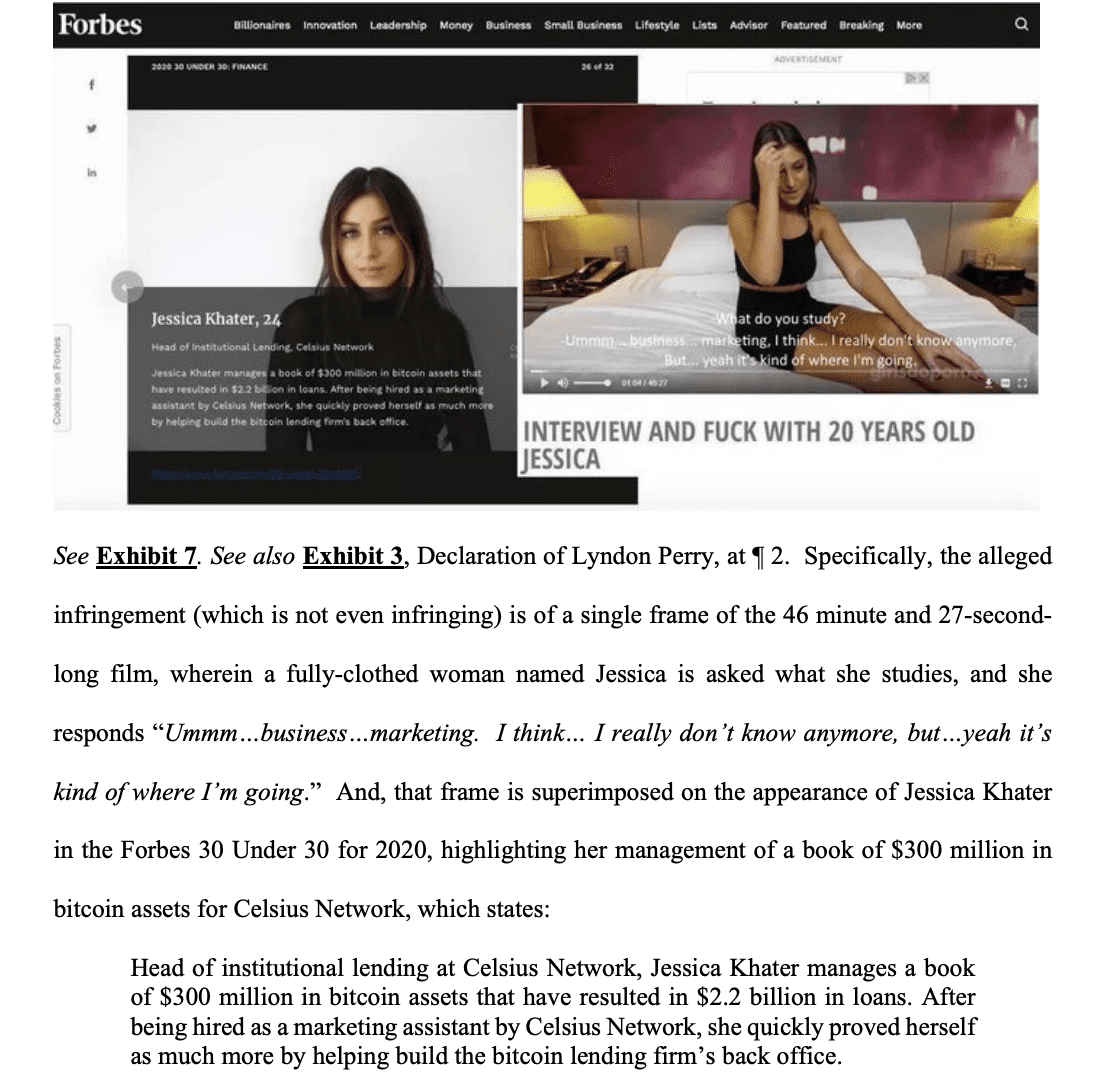
Shortly thereafter Mr. Perry posted a collage about the company. He noticed that a Celsius executive was a former Girls Do Porn actress, and she was later profiled in a Forbes 30-under-30 piece about managing $300 million in bitcoin assets for Celsius. Perry then juxtaposed the screen shot of the Forbes profile of her with a still image from a porn movie (where she was fully clothed). That still was from the prelude in the movie, where she was talking about studying business and marketing. Mr. Perry commented “Same company, btw.”
The Plaintiff claimed that the infringement was of a single frame of the 46 minute and 27-second long film. In that frame, where she is giving a pre-movie interview, she was asked what she studies, and she responded “Ummm…business…marketing. I think… I really don’t know anymore, but…yeah it’s kind of where I’m going.”
That frame is superimposed on the appearance of her in the Forbes 30 Under 30 for 2020, highlighting her management of a book of $300 million in bitcoin assets for Celsius Network.
Mr. Perry posted this for the purpose of commenting on Celsius’ marketing and comparing it to critical reporting on the company. Perry’s reproduction of one still frame was in service of this commentary. The implied message was that maybe Celsius had failed when this was an executive at the company. Whether you agree with that theory or not, Perry had a right to express it.
Copyright law exists to protect creative works, not to stop you from engaging in commentary or criticism.
We argued that Mr. Perry should have every right to use a single still image as an illustration of his critique of Celsius and its business practices. We argued that Fair Use, found at 17 U.S.C. § 107, gives breathing room to free speech by limiting the ability to use the Copyright Act to stifle bona fide speech like this.
Winning a fair use case at the motion to dismiss stage is often difficult. Mark Lemley wrote, “Because fair use relies upon a vague, multi-factor test, it is often impossible to know ex ante whether any particular use will qualify as fair.” Similarly, Lawrence Lessig calls fair use “the right to hire a lawyer.” Courts generally punt on this issue and require long and drawn out litigation before deciding in favor of a fair use defense.
Here, had that happened, free speech would have been the real victim.
This intersection of free speech and intellectual property law is an area of particular interest to attorney Randazza. His thesis from the Università di Torino discusses free speech and intellectual property rights. See Marc J. Randazza, Freedom of Expression and Morality-Based Impediments to the Enforcement of Intellectual Property Rights, 16 Nev. L.J. 107 (2015). He further published on fair use and the DMCA here: Marc J. Randazza, Lenz v. Universal: A Call to Reform Section 512(f) of the DMCA and to Strengthen Fair Use, 18 Vand. J. Ent. & Tech. L. 743 (2016).