

Alan R. Levy and Lisa S. Vandever—politically active residents of Rahway, New Jersey—are appealing a lower-court ruling allowing a retaliatory lawsuit to proceed against them despite New Jersey’s recently enacted Anti-SLAPP statute, the Uniform Public Expression Protection Act (UPEPA).
Levy and Vandever are a politically active “mixed” couple. Vandever ran in the 2024 Democratic primary for Rahway City Council, earning 31% of the vote. Levy is an elected member of the Union County Republican Committee. For years, both regularly participated in Rahway Community Voice (RCV), a 20,000-member Facebook group that presents itself as a community “public square.”
Levy and Vandever were censored and banned from RCV. One of the admins responsible for the ban, Tom O’Reilly, also served as Chair of the 2024 Rahway Democratic Campaign Committee. Vandever had recently run a primary challenge against a Democratic incumbent backed by that same Committee. The timing of O’Reilly’s censorship appeared suspect, at least to Levy and Vandever.
Levy and Vandever filed suit in New Jersey Superior Court, alleging unlawful viewpoint discrimination under long-standing New Jersey constitutional protections for speech in privately owned spaces that function as public forums, consistent with Pruneyard Shopping Ctr. v. Robins, 447 U.S. 74 (1980).
O’Reilly retained the very capable law firm of Rainone Coughlin & Minchello, which also serves as longtime municipal counsel for the City of Rahway. The firm has been criticized by some government watchdogs and political editorials the appearance that political donations by government contractors sometimes coincide with lucrative public contracts. In 2024, the firm donated nearly $50,000 to Rahway Democratic Party committees while billing the City close to $1 million annually in taxpayer-funded legal fees. Naturally, this could simply be a coincidence. The Mayor of Rahway and all nine City Council members are members of O’Reilly’s Democratic Campaign Committee. Again, doesn’t necessarily mean they have any political bias.
The trial court denied O’Reilly’s motion to dismiss, finding sufficient evidence that Levy and Vandever were banned for criticizing Rahway’s elected officials, and this violated the New Jersey Constitution. Following that ruling, the remaining RCV administrators—who had no ties to the Democratic Committee—contacted the plaintiffs to settle the case. They were willing to reinstate Levy and Vandever.
That settlement collapsed after Rainone Coughlin & Minchello assumed representation of all defendants. The timing does not necessarily prove that it happened because of the firm, it simply is a fact that one happened, and then the other happened. Correlation does not mean causation.
Levy and Vandever however, believed that it was not simply correlation, but causation. Thus, they sought to disqualify the firm due to what they perceived as conflicts arising from Rainone Coughlin’s simultaneous representation of multiple parties with divergent interests.
The disqualification motion was denied.
If you’re a lawyer, you know that most disqualification motions are. The standard is high, and even if the standard is met, judges are loath to grant them.
This is where it gets really weird.
The three defendants then filed a counterclaim accusing the plaintiffs of “malicious abuse of process” for filing the disqualification motion and included allegations that Levy and Vandever’s public criticism of Rahway officials and the firm itself were at issue. This conduct, however, fit squarely within the First Amendment and the Litigation Privilege Doctrine.
Essentially, you get to criticize the government and its lawyers. You also get to file motions, even motions that lose, without it creating tort liability. If you file a frivolous motion, then there are consequences for that — but one of those consequences is not a lawsuit. If it was, think about how any lawsuit could ever move forward — every failed motion would mean another counterclaim.
Levy and Vandever moved to dismiss the counterclaim under New Jersey’s Anti-SLAPP law, UPEPA, which is designed to halt lawsuits intended to punish or chill public participation. The grounds are pretty clear – that you can’t be sued for just filing a motion … not even if you also said bad things about the government.
The defendants opposed, as you would imagine they would, prompting our reply brief.
The motion was denied on grounds that, well, if you know anything about law, you read it and come to your own conclusion. Let’s just say that if you read it and you are confused, you are in good company.
Our position is pretty clear though as articulated in our appeal.
And bless Rainone Coughlin’s hearts, they opposed on truly adorable grounds.
Our reply is here.
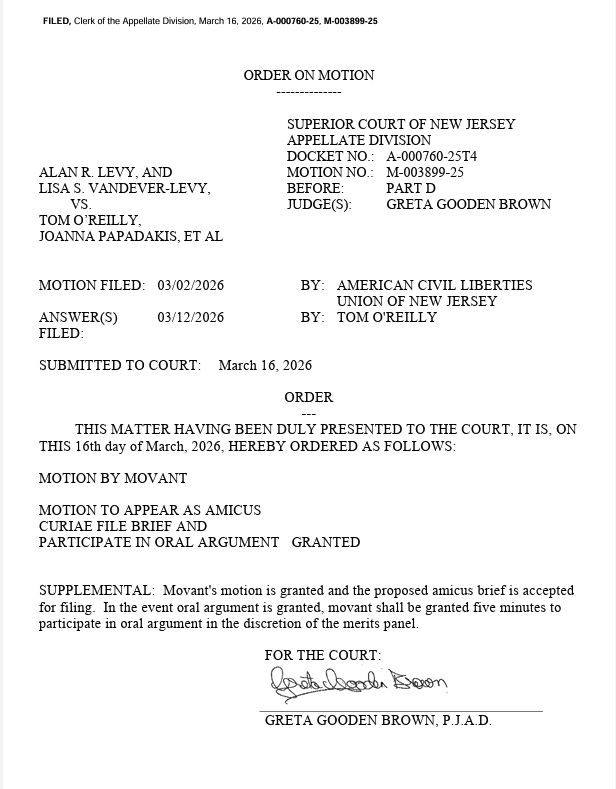
In a pleasant surprise, the ACLU of New Jersey filed an amicus brief in support of our position.
And the Rainone Coughlin firm filed an objection to the ACLU’s brief here, which is … just stunning. Probably the best reading material in the entire case. Our comment on it is best summed up by David. Well, and the fact that it was immediately and summarily rejected.
The appeal is both about political speech and the proper functioning of our court system. Even if you say bad things about the government, you shouldn’t be the subject of a lawsuit just because you filed a motion that failed.